Bond vs Bail: 7 Core Differences for Minnesota Jail Release
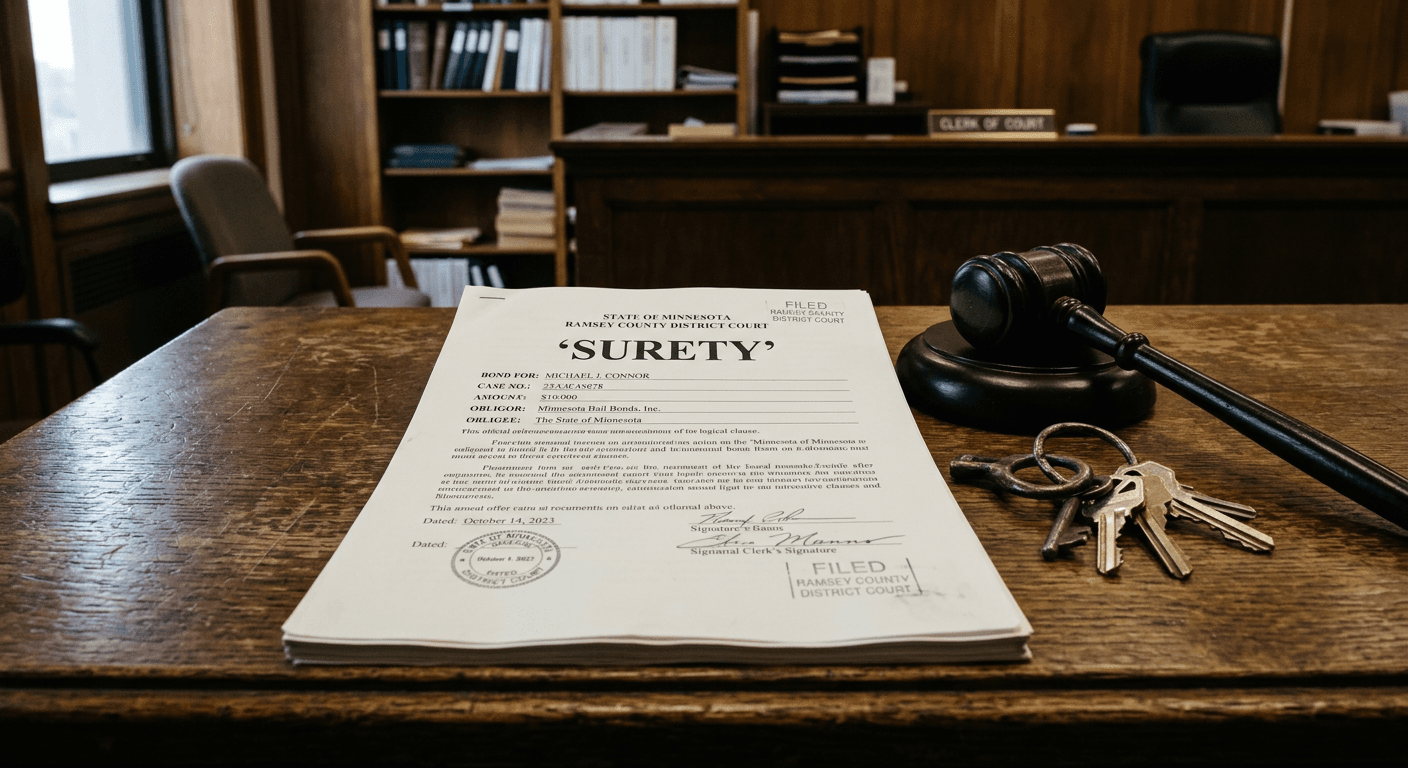
A phone rings at 2 AM from a Minnesota county jail, and the caller tells you a judge has set a steep bail amount. The immediate question is whether you need to secure a bond vs bail before morning, because confusing the two determines exactly how much cash leaves your bank account today. For families navigating an arrest in counties like Anoka or St. Louis, misunderstanding the bail vs bond meaning often leads to drained savings accounts or unnecessary days spent sitting in a cell. The two terms are used interchangeably in casual conversation, but in a courthouse, they represent entirely different mechanisms for securing freedom.
Quick Summary
When securing a release from a Minnesota jail, understanding bond vs bail dictates your financial strategy. Bail is the total cash amount demanded by the court, while a bond is the surety contract purchased to cover that amount without paying it in full.
- Bail requires delivering the entirety of the court's assessment in cash to the jail.
- A bail bond involves a third party assuming the financial liability.
- Minnesota law requires a statutory minimum down payment on qualifying bonds.
- Cash bail ties up personal liquidity until the case fully closes.
- Surety bonds process faster because agents bypass public administrative queues.
Table of Contents
- Why Getting Bond vs Bail Wrong Costs You Time
- 1. The Total Court Assessment
- 2. Upfront Out-of-Pocket Expenditure
- 3. The Contractual Framework
- 4. Addressing Unconditional Release
- 5. Case Closure and Financial Liability
- 6. Speed of the Jail Release Process
- 7. Handling High-Risk Offenses
- Mapping Your Release Strategy
- FAQ
- Recommended Reads
Why Getting Bond vs Bail Wrong Costs You Time
Before diving into the mechanics, we must evaluate these options against two strict criteria: immediate financial liquidity and the assumption of risk. Every jail release method requires someone to put capital on the line to guarantee a court appearance. The core difference lies in whose capital is at risk and how much of it must be produced today. Choosing the wrong mechanism either traps your personal cash in the court system for a year, or leaves a defendant in custody because a surety agreement was unnecessarily delayed.
1. The Total Court Assessment
Bail sets the target, the bond maps the route
Is bail and bond the same thing? The shortest answer is no. Bail is the specific dollar figure the court demands to allow a defendant to leave custody while their case is pending. It is an assessment handed down by a judge based on flight risk and the severity of the charges. A bond, conversely, is simply the financial instrument used to satisfy that demand.
When a judge sets a specific bail amount, that number represents the court's leverage over the defendant. If you post cash bail, you hand the court the entire total. If you choose the surety route, you purchase a financial product that guarantees the full amount on your behalf. To understand exactly what you are dealing with, look up the defendant on the county roster and find the specific assessment number the judge entered into the record.
The severe limit of cash bail is that it treats every family as if they have vast reserves of liquid wealth. If the total assessment reaches into the tens of thousands, utilizing cash bail means draining emergency funds that will likely be needed later to retain a defense attorney. Anyone facing a complex case that will stretch on for months should avoid tying up their entire net worth in a courthouse holding account.
2. Upfront Out-of-Pocket Expenditure
Direct cash depletes savings immediately
Handing a cashier's check to the jail clerk instantly ties up a family's liquid savings for months. When you pay bail to a facility like the Anoka County jail, you must produce the entirety of the judge's required amount. There are no payment plans with the court clerk. Whatever total the court sets, you must deliver that exact assessment in acceptable funds.
A surety bond removes this upfront barrier. Instead of paying the full amount to the court, you pay a specialized agency a fraction of the total. In Minnesota, by law, you can put a statutory minimum down on qualifying bonds, with no credit check and flexible payment plans to cover the remainder of the premium. The agency then issues a guarantee to the court for the entire assessment. You can check your immediate out-of-pocket requirement tonight by calculating the state-mandated percentage of the roster's bail amount.
However, a surety agreement cannot be executed without that initial down payment. If a family cannot assemble the legal minimum fraction required by the state, the bondsman cannot legally file the paperwork. For deeply impoverished individuals with extremely low bail amounts - such as a nominal assessment for a minor administrative violation - skipping the bondsman and paying the cash directly is the only logical path.
3. The Contractual Framework
Surety agreements add a professional intermediary
What is a bail bond at the paperwork level? It is a three-party surety contract that alters the legal liability of the release. When you pay cash bail, it is a two-party transaction between the depositor and the Minnesota court system. If the defendant flees, the court simply keeps your cash. A bond introduces a licensed intermediary who issues a promissory note to the court on your behalf.
When you sign for a bond, you become an indemnitor. You are signing a contract guaranteeing the bondsman that the defendant will attend every mandated hearing. If the defendant misses court and cannot be located, the bondsman owes the court the full bail amount, and they will immediately seek that sum from you. Before committing, you must read the indemnity agreement to verify exactly whose assets are on the line if things go wrong.
Practical rule: Never co-sign a surety agreement if you do not intimately know where the defendant lives, works, and spends their free time, because you are financially underwriting their reliability.
This contractual structure is entirely unsuitable for casual acquaintances. If a coworker or a distant relative asks you to help them out of the Chisago county jail, co-signing a bond exposes you to massive liability if they decide to leave the state. In those scenarios, unless you are willing to risk the entire face value of the bail, you must decline the paperwork.
4. Addressing Unconditional Release
Removing pre-trial restrictions requires higher backing
Minnesota judges routinely issue two separate bail figures during an arraignment: a conditional amount and an unconditional amount. The conditional bail is lower, but it forces the defendant to submit to Electronic Home Monitoring (EHM), random urinalysis (UAs), and restrictive travel bans. The unconditional bail is set much higher, but allows the defendant to leave jail with no pre-trial restrictions, permitting them to return to work immediately.
Using a surety to meet that higher unconditional number is one of the primary reasons families choose to work with an agency. Because the unconditional amount is often unaffordably high in cash, securing a bond allows the defendant to avoid the daily fees and employment disruptions associated with EHM. You should always ask the booking officer to provide both the conditional and unconditional figures before making a financial decision.
Choosing the unconditional route requires a proportionally larger down payment. Calculating the statutory premium on a massive unconditional bail total yields a significantly higher immediate cost than the premium on a lower conditional bail. Families who lack the income to manage the higher payment plan must abandon the unconditional option and accept the court's pre-trial restrictions instead.
5. Case Closure and Financial Liability
Court refunds exclude the surety premium
What is bail vs bond when the legal proceedings finally end? The distinction comes down to how the final accounting is handled. Once a judge issues a final disposition - whether through a dismissal, a plea, or a verdict - the court formally discharges the liability. If you posted full cash bail, the court will issue a refund check to the depositor, though they will often automatically deduct any court fines, restitution, or fees from that balance first.
When you use a bond, there is no refund from the agency. The 3%-5% premium you paid to the bondsman is their fully earned fee for risking their capital and providing the service. Once the case closes, the surety liability is lifted from your shoulders, but the money you paid for the premium is permanently gone. You can verify your liability status by tracking the case disposition date in the Minnesota court records system.
This means a bond is a terrible choice if you have ample liquid cash and anticipate heavy court fines that you want paid directly out of your posted funds. Cash bail handles that fine deduction automatically. A bond preserves your current bank balance but requires you to pay those court fines out of pocket later, on top of the premium you already paid.
6. Speed of the Jail Release Process
Professional filings bypass the administrative queue
When you post bond vs bail, the friction at the jail's intake desk changes dramatically. Walking into a facility to pay cash bail requires waiting for an administrator who is authorized to handle large sums of currency. Many county jails restrict cash intake during shift changes, lockdowns, or overnight hours, and they require exact change or highly specific cashier's checks.
Professional agents bypass this friction. Agencies handling Minnesota DWI bail bonds maintain established channels and digital filing access with the records departments. Because they file surety paperwork rather than counting out physical cash, they can execute a release while the public lobby is closed. You can test this by calling the duty officer and asking what hours they actually process public cash payments.
Practical rule: If a jail facility goes into an unannounced lockdown for security reasons, neither cash nor a surety filing will trigger an immediate release until normal operations resume.
A surety filing accelerates the administrative paperwork, but it cannot override mandatory legal holds. If the arrest involves intoxication, the jail will enforce a strict sobering period regardless of how quickly the bond is filed. Families who hire an agent expecting to bypass a mandatory 12-hour hold will be disappointed, as the release will only occur once the jail's medical staff clears the individual.
7. Handling High-Risk Offenses
Warrants and severe charges demand strict underwriting
Is bond the same as bail when dealing with an active felony warrant? Legally, warrants dictate the court's requirements upfront, often stamping "cash or bond" directly on the document alongside a massive dollar figure. Because a warrant implies the person has already missed court or evaded law enforcement, the risk of them fleeing again is mathematically higher.
Before an agency will post a bond for a severe warrant out of St. Louis County, they must heavily underwrite the risk. The bondsman will investigate the defendant's ties to the community, their employment history, and the strength of the indemnitor backing the contract. You must secure the exact statute code listed on the active warrant before approaching an agent so they can properly assess the legal exposure.
The limit here is the bondsman's discretion. Unlike the court, which must accept your cash if you have it, an agency can simply refuse to write the policy. If the defendant is an out-of-state resident with a history of jumping bail, an agent will reject the application. In those high-risk scenarios, a bond ceases to be an option, and producing the full cash amount becomes the only path forward.
Mapping Your Release Strategy
Choosing your path depends entirely on your immediate cash reserves and your tolerance for liability. If your primary bottleneck is total liquidity - meaning you cannot afford to drain $15,000 from your bank account today without defaulting on your mortgage - take the surety route. The structured down payment keeps your savings intact while securing the release.
Conversely, if the total assessment is under $500, you have the cash in hand, and you do not want to owe non-refundable premiums, bypass the professional intermediary and pay the court directly. Ultimately, contacting a licensed Minnesota bondsman directly can clarify exactly what an unconditional release will cost your family, allowing you to make a decision based on hard numbers rather than panic.
FAQ
What is the bail vs bond meaning in simple terms? Bail is the total financial amount a judge requires to release someone from jail. A bond is a surety contract you purchase from an agency to cover that total amount on your behalf.
Is bail and bond the same thing when paying the court? No. Paying bail means handing the total cash amount directly to the jail. Paying a bond means giving a non-refundable percentage to a licensed agent who guarantees the rest to the court.
Do you get your money back if you post bond vs bail? If you post cash bail, the court refunds the money at the end of the case (often minus fines). If you use a bond, the premium you paid to the agency is non-refundable, as it acts as their service fee.
How long does a surety agreement last? The agreement lasts until the judge formally closes the case, whether that takes a few weeks or over a year.