Carver County Bail Bonds: Getting Released from the Chaska Jail
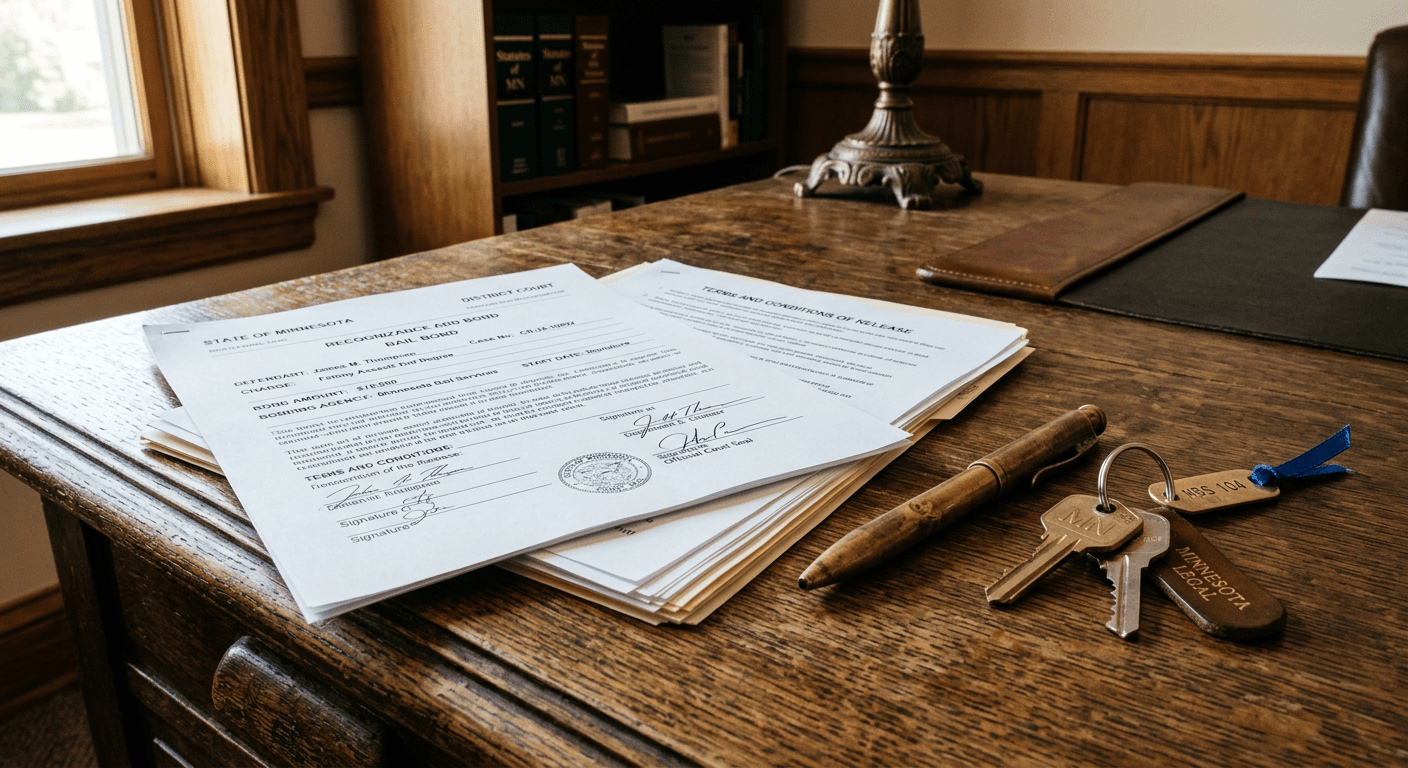
When an individual is taken into custody within Carver County, the transport vehicle inevitably heads to the detention facility located at 606 East 4th Street in Chaska. For the detainee and their family, the immediate reality is a sudden loss of communication and a highly rigid bureaucratic process. Navigating carver county bail bonds requires understanding exactly what happens behind those doors, how Minnesota's dual-bail system dictates release terms, and the specific mechanical steps required to post a surety bond. The decisions made in the first few hours dictate whether the defendant returns to work the next day or remains incarcerated through the weekend.
Quick Summary
Securing a release from the Chaska jail involves navigating mandatory intake procedures, warrant checks, and Minnesota's specific bail statutes. A surety bond replaces the need to pay the full bail amount in cash, allowing a third-party indemnitor to secure the defendant's release for a fraction of the total cost.
- Minnesota law requires judges to offer an unconditional bail option.
- Unconditional bail removes costly pretrial restrictions like Electronic Home Monitoring (EHM).
- By law, 3%-5% down on qualifying bonds, no credit check, flexible payment plans are available.
- Release times depend heavily on jail shift changes and out-of-county warrant holds.
Table of Contents
- The Carver County Arrest and Intake Sequence
- How Conditional and Unconditional Bail Differ in Minnesota
- The Mechanics of Securing a Surety Release
- DWI Arrests and Warrant Resolutions in Carver County
- What Slows Down a Chaska Jail Release
- The True Cost of Electronic Home Monitoring
- Comparison Table: Release Paths and Restrictions
- FAQ
- Recommended Reads
The Carver County Arrest and Intake Sequence
The sequence inside the Chaska facility operates on strict protocols that cannot be bypassed. Upon arrival, the detainee is placed in a temporary holding area where the booking process begins. This is not a fast procedure. The jail staff must conduct a medical and psychological screening before moving to the physical identification phase.
Next comes the Live Scan fingerprinting. These digital prints are transmitted directly to the Minnesota Bureau of Criminal Apprehension (BCA) and the National Crime Information Center (NCIC). The primary purpose of this step is to verify the detainee's identity and determine if they have active warrants in other jurisdictions. If the system flags an outstanding warrant from Pine County or Isanti County, the Carver County release process halts until that secondary warrant is addressed.
Simultaneously, the arresting officer submits the probable cause statement. If the arrest occurred without a prior warrant, a judge must review this statement within 48 hours to determine if there is sufficient legal ground to hold the individual. Bail cannot be posted until a bail amount is officially set by the court schedule or dictated by a standard bail schedule for specific offenses.
How Conditional and Unconditional Bail Differ in Minnesota
Minnesota operates under a dual-bail system. The state constitution and subsequent statutes mandate that a defendant must be offered a bail option that does not impose conditions on their pretrial liberty, other than appearing for court and remaining law-abiding. As a result, a judge in Carver County will typically set two distinct bail amounts.
The conditional bail amount is financially lower. However, it requires the defendant to sign an agreement accepting severe restrictions. These often include Electronic Home Monitoring (EHM), Secure Continuous Remote Alcohol Monitoring (SCRAM) bracelets, mandatory weekly check-ins, unannounced urinalysis (UA) testing, and strict travel bans. The defendant is financially responsible for the daily rental fees of the monitoring equipment and the cost of every UA test.
The unconditional bail amount is financially higher. Posting this amount means the defendant is released with zero pretrial restrictions. There is no ankle monitor, no travel restriction within the state, and no daily testing fees.
Practical rule: Always calculate the total out-of-pocket cost of conditional release over a six-month pretrial period before accepting it. Equipment fees and testing costs frequently exceed the premium of a higher unconditional bond.
Choosing the unconditional route requires posting the larger amount, which is why most defendants use a surety bond.
The Mechanics of Securing a Surety Release
A surety bond is a financial guarantee made by a licensed bail bond agency to the Carver County court. The agency promises to pay the full bail amount if the defendant fails to appear for their scheduled hearings.
To initiate this, an indemnitor - usually a family member or close friend - signs a contract with the agency. The indemnitor pays a premium, which is a non-refundable percentage of the total bail amount. By law, 3%-5% down on qualifying bonds, no credit check, flexible payment plans dictate how this initial financial transaction operates in Minnesota. The indemnitor assumes responsibility for ensuring the defendant attends court. If the defendant flees, the agency has the authority to locate and return them to custody, and the indemnitor is liable for the full bail amount.
When you begin searching for a bondsman near me, the goal is to find an agent licensed in Minnesota who understands the specific operational rhythms of the Chaska jail. Once the premium is paid and the paperwork is signed, the agent physically delivers the bond to the jail. The jail staff then verify the bond, cross-check for any newly dropped warrants, and begin the discharge process.
DWI Arrests and Warrant Resolutions in Carver County
Driving While Impaired (DWI) arrests trigger a specific set of statutory rules in Minnesota. If an individual is arrested for a 1st, 2nd, or 3rd-degree DWI in Carver County, they are subject to mandatory hold periods and maximum bail statutes. For a gross misdemeanor DWI, state law allows the court to set a maximum bail amount calculated as a statutory multiple of the maximum fine.
In these scenarios, the court often pushes heavily for conditional release, requiring the immediate installation of a SCRAM bracelet. However, the defendant still retains the right to post the maximum unconditional bail. Posting the unconditional bond bypasses the SCRAM requirement entirely. Because DWI cases often take several months to resolve, avoiding the daily fees of alcohol monitoring is a massive financial advantage.
Active warrants operate differently. If a judge in Carver County issues a bench warrant for a missed court date or a probation violation, the warrant specifies a bail amount. An individual can arrange a surety bond to clear the warrant before law enforcement executes it. By coordinating with an agent to post chaska jail bail bonds proactively, the defendant can often walk into the facility, process the paperwork, and walk out without spending the night in a cell. This preemptive approach prevents the disruption of being arrested at work or during a traffic stop.
What Slows Down a Chaska Jail Release
A common misconception is that paying the bond immediately results in the doors opening. The reality is that jails are secure facilities driven by strict procedural mandates. Several specific failure modes will delay a release, and distinguishing between them prevents unnecessary panic.
First is the Out-of-County Warrant Hold. If the Live Scan reveals an active warrant in St. Louis County, Carver County legally cannot release the detainee until the secondary warrant is cleared. The fix requires posting a separate bond for the St. Louis County charge, or waiting for that county to arrange transport.
Second is the Intoxication Hold, commonly referred to as a "Rule 4" hold. If a detainee arrives highly intoxicated, the jail will not process their release - even if a bond is sitting on the desk - until their blood alcohol content drops below a safe threshold. The facility assumes liability for the individual's safety upon release, meaning a sobering period is non-negotiable.
Third is the Shift Change Delay. Detention facilities conduct mandatory inmate counts during shift changes, typically around 6:00 AM and 6:00 PM. During these windows, the facility is entirely locked down. No one is booked in, and no one is released until the physical count perfectly matches the roster. If a bond is posted at 5:45 PM, the release process will halt until the count clears at 7:00 PM or later.
Finally, Court Schedule Alignment causes weekend delays. If an arrest occurs late Friday night and the charge requires a judge to set bail, the detainee must wait for the Monday morning court calendar. No agency can override a judge's required initial appearance. When facing these delays, working with experienced bail bonds near me ensures that you have an advocate who can verify exactly which of these four hurdles is currently pausing the process.
The True Cost of Electronic Home Monitoring
Conditional release relies heavily on Electronic Home Monitoring (EHM), a system that delegates the cost of incarceration directly to the defendant. EHM requires a landline or a specialized cellular unit, an initial setup fee, and a daily monitoring charge that scales in cost depending on the vendor and the level of supervision (e.g., GPS tracking versus simple radio frequency).
Over a standard six-month pretrial period, the daily fees for EHM can easily compound into an overwhelming out-of-pocket expense. Furthermore, EHM dictates exact schedules. If a defendant works in construction or a trade with variable hours, the rigid schedule of EHM often leads to technical violations. If traffic delays a return home by 15 minutes, the monitoring center registers an unauthorized absence, which can trigger a warrant for arrest and the revocation of bail.
Practical rule: Never accept an EHM-based release if your employment requires variable hours, on-call shifts, or multi-site travel, as the rigid tracking parameters will inevitably result in a technical violation.
Choosing an affordable bail bond to secure unconditional release eliminates these risks. The premium paid to the surety agency is a single, one-time transaction. There are no daily fees, no equipment setup costs, and no risk of a technical violation due to a late shift at work. The financial predictability of the unconditional route is why it remains the preferred option for defendants who must maintain their employment while fighting a case.
Comparison Table: Release Paths and Restrictions
| Release Path | Initial Financial Requirement | Pretrial Restrictions (EHM/UA) | Risk of Technical Violation | Total Long-Term Cost |
|---|---|---|---|---|
| Unconditional Surety Bond | 3%-5% down on qualifying bonds | None | Zero | Fixed one-time premium |
| Conditional Release (Cash) | Lower flat cash amount | High (EHM, SCRAM, Check-ins) | High (Strict schedules) | Cash + Daily EHM/UA Fees |
| Remain in Custody | None | Total loss of freedom | N/A | Loss of employment/income |
FAQ
What happens if I cannot afford the full bail amount set by the Carver County judge? You do not have to pay the full amount out of pocket. You can utilize a surety agency to post an unconditional bond on your behalf. You act as the indemnitor and pay a fraction of the total amount as a premium, which legally satisfies the court's financial requirement for release.
How long does the release process take at the Chaska jail after the bond is posted? Once the paperwork is delivered to the jail staff, release typically takes between two and four hours. This timeline expands if the facility is in the middle of a shift change, responding to a medical emergency, or waiting for an intoxication hold to expire.
Can I post bail for someone in Carver County if I live in another Minnesota county? Yes. You can act as the indemnitor and sign the necessary paperwork electronically or at a local office, regardless of which Minnesota county you reside in. The bond itself is still delivered to the Chaska facility.
What is the difference between a cash bail and a surety bond? Cash bail requires depositing the entire bail amount directly with the court; the money is held until the case concludes. A surety bond involves paying a smaller, non-refundable premium to an agency, which then issues a legally binding financial guarantee to the court for the full amount.
Are there restrictions on where I can travel after posting an unconditional bond? Under an unconditional bond, the court imposes no pretrial travel restrictions or monitoring requirements. You are only legally obligated to appear at all scheduled court hearings and remain law-abiding.